
FIT
One major factor that drives people to choose a custom bicycle frame is the need to achieve a proper fit not available from so-called “stock” designs. Waterford includes made to measure geometry (within certain limits listed below) on all 14-series, 22-series and 33-series models.
We recommend availing yourself of professional fitting services, particularly if you have fit issues with your current bike. Most Waterford dealers have extensive experience and/or formal fit training to help you achieve your ideal riding position.
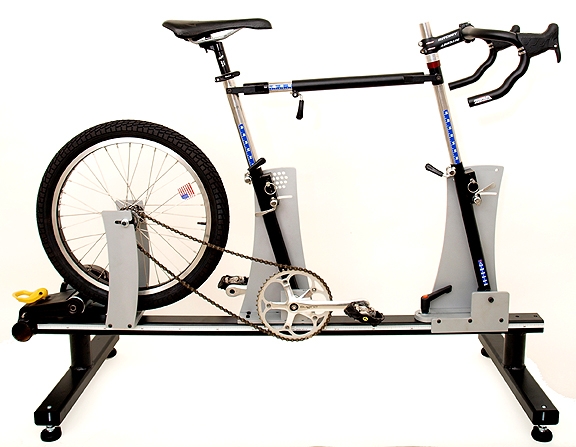
Waterford looks to achieve three fit related goals:
- Biomechanical efficiency: Exercise physiologists look at the human body as a system of levers and pulleys. With the right position, these levers can work efficiently. In the wrong position, they can cause injury as well as suffering. We recommend evaluating biomechanical efficiency in light of the type of riding. Efficiency will be defined differently for a time trialist than for someone building a cafe bike.
- Comfort: Riding comfort is one of the principal indicators of biomechanical efficiency as well as a natural objective of bike fit. If you are comfortable you will perform better.
- Degrees of freedom: to adjust a fit over time: Your ideal bike fit is truly dynamic, changing in small measure from day to day and even over the course of a ride. Certainly over the life of your Waterford, most people can expect the need to adjust their fit. We take pains to consider the need to adjust the stem height and length, the saddle height and fore/aft position and so on when designing a bicycle frame.
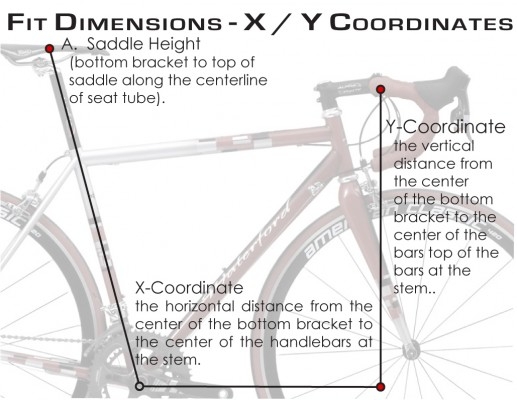
To specify the fit, we need to locate the saddle and handlebars in relation to the center of the bottom bracket. With this information, we can design the ideal frame to fit underneath.
Basic fit information helps us anticipate your needs when designing your Waterford. Height, weight and age provide a general context for the fit, while providing a cross-check on other specifications.
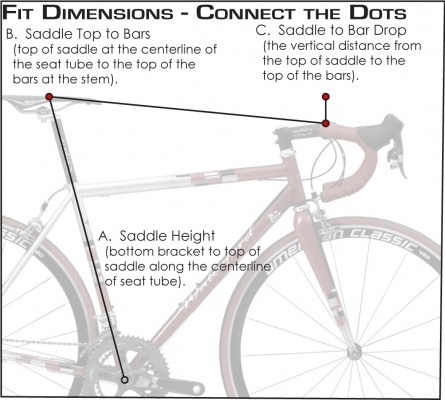
To locate the saddle, we need a saddle height and a recommended seat angle. The saddle height is measured along the centerline of the seat tube, with the saddle located in the middle of the saddle rails. This locates the saddle in relation to the bottom bracket. In some cases, we may request an adjustment to the seat angle to prevent excessive toe overlap.
There are two methods for specifying the handlebar position:
Connect the dots: This method is designed to locate the bars and saddle without the use of special tools:
X/Y coordinates: With this method the horizontal (“X”) and vertical (“Y”) distance is determined from the center of the bottom bracket to the center of the handlebars.
Toe Overlap: Toe overlap refers to the amount by which the toe of the shoe can overlap the front wheel during certain parts of the pedal stroke. It’s great if it can be avoided altogether. However, as frame sizes get smaller the risk and extent of toe overlap increases, necessitating changes to the frame and fork design.
In extreme cases, toe overlap represents a safety issue, particularly on fixed gear bikes. This is one reason Waterford pays attention to it.
Some riders willingly accept some amount of toe overlap in order to achieve their desired handling, a required wheel size, and other objectives. We ask for an appraisal of your tolerance of toe overlap to ensure a proper design. What can we do to reduce toe overlap?
- Steepen the seat angle.
- Lengthen the top tube.
- Slacken the head angle (and increase the fork offset).
- Choose a smaller front wheel/tire/fender combination.